Brevard County Real Estate News &  Real Estate Market Trends

You’ll find our blog to be a wealth of information, covering everything from local Brevard County market statistics and home values to community happenings. That’s because we care about the community and want to help you find your place in it. Please reach out if you have any questions at all. We’d love to talk with you!

Dec. 16, 2025

Is Now a Good Time to Buy a Brevard County Home? What Fence-Sitting Buyers Need to Know


Is Now a Good Time to Buy a Brevard County Home? What Fence-Sitting Buyers Need to Know

Buying a home is one of the biggest decisions most people make in life. It’s exciting, nerve-racking, and confusing — especially in today’s market when so many of us are wondering: Is now the right time to buy?

Let’s break it down together in a way that’s easy to understand — no jargon, just real talk.


🏡 1. Mortgage Rates Are Better Than They Were… But Still High

Good news first: mortgage rates have come down from the highs we saw earlier in 2025. Some averages are hanging around the low-to-mid 6% range, which is lower than they were for a while. That means your monthly payment could be more affordable than it would have been a year ago. (Redfin)

That said, we’re still not in the super-low mortgage rate era of the early 2020s. So if you’re waiting in the hopes of ultra-cheap borrowing costs, that might not happen overnight. (Money)

👉 Takeaway: Improved rates do help buyers — but they’re still higher than the historic lows many people remember.


📈 2. Inventory Is Up — Which Can Be a Huge Advantage

One of the biggest frustrations buyers often face is competition — multiple offers, bidding wars, homes selling above asking price.

Right now, there are more homes on the market than there have been in recent years, which means:

  • Less pressure to make rushed offers

  • More time to compare homes

  • A better chance of negotiating on price

That’s thanks to inventory climbing steadily over the last couple of years. (Yahoo Finance)

💡 More homes on the market = more choices and room to negotiate.


💸 3. Affordability Still Isn’t “Easy”

Here’s the honest part: even with lower rates and more inventory, many homes are still priced above what a typical buyer can comfortably afford. In fact, as a national snapshot, over 75% of homes on the market are out of reach for someone earning an average U.S. income. (Bankrate)

That doesn’t mean you can’t buy — it just means:

  • You’ll want smart financial planning

  • You might have to consider different neighborhoods

  • You should get preapproved so you know exactly what you can afford


📊 4. Local Markets Matter More Than Ever

The national market gives a big picture… but your local market makes the real difference.

In some cities, prices are still rising. In others, values have dipped or stayed flat. Some areas have a surplus of listings, others do not. (Reuters)

Rule of thumb: Before charging ahead or stepping back, look closely at your specific area — that’s where you’ll find the true answer for you.

✨ Pro tip: Partner with a local agent who can show you trends in your city and neighborhood — not just the national averages.


🧠 5. Your Personal Situation Matters Most

Here’s the honest truth: the best time to buy isn’t about the calendar — it’s about you.

Ask yourself:

  • Do I have stable income and savings?

  • Can I afford the down payment and emergency funds?

  • Am I planning to stay in this home for at least 5–7 years?

  • Am I emotionally ready for the responsibilities of homeownership?

If you answered yes to most of those, you might be in a great spot to buy now.

If not, that’s okay — waiting, saving a bit more, and strengthening your finances can be a smart strategy too.


🏆 Bottom Line: It Can Be a Good Time to Buy — but Only If It’s Right for You

So what’s the verdict?

Yes — in many markets, right now can be a good time to buy.
Mortgage rates are easing from earlier highs, inventory is more favorable for buyers, and competition isn’t as fierce as before. (Redfin)

⚠️ But affordability challenges and personal financial readiness still matter more than market timing. If the numbers don’t add up for your budget — or you’re not ready to settle down long-term — it might make sense to wait and prepare. (Bankrate)

At the end of the day, the smartest move is informed and personalized.
 

Nov. 6, 2025

Understanding the Recent Fed Rate Cuts and Their Impact on Mortgage Rates

Understanding the Recent Fed Rate Cuts and Their Impact on Mortgage Rates

TLDR: Despite recent Fed rate cuts, mortgage rates have unexpectedly increased. This blog post explores the reasons behind this phenomenon, focusing on economic indicators and Fed Chair Jerome Powell's statements that influenced market reactions.

The Federal Reserve has recently cut interest rates again, but contrary to expectations, mortgage rates have increased. This has left many realtors and consumers puzzled. In this blog post, we will break down the events surrounding the Fed's rate cuts and explain why mortgage rates have not followed the anticipated downward trend.

The Context of Rate Cuts

For the past three years, many Americans have been eagerly awaiting lower mortgage rates. Historically, when the Fed lowers rates, it is expected that mortgage rates will decrease as well. However, this has not been the case during the last two rate cuts, which occurred on September 17 and October 29. Let's delve into these events to understand the underlying reasons.

The September Rate Cut

On September 17, the Fed cut rates by a quarter point. This move was largely anticipated by the market and had already been factored into mortgage rates. However, instead of decreasing, mortgage rates increased. The reason for this unexpected rise was a better-than-expected jobless claims report that surprised the market. 

Economic Indicators and Market Reactions

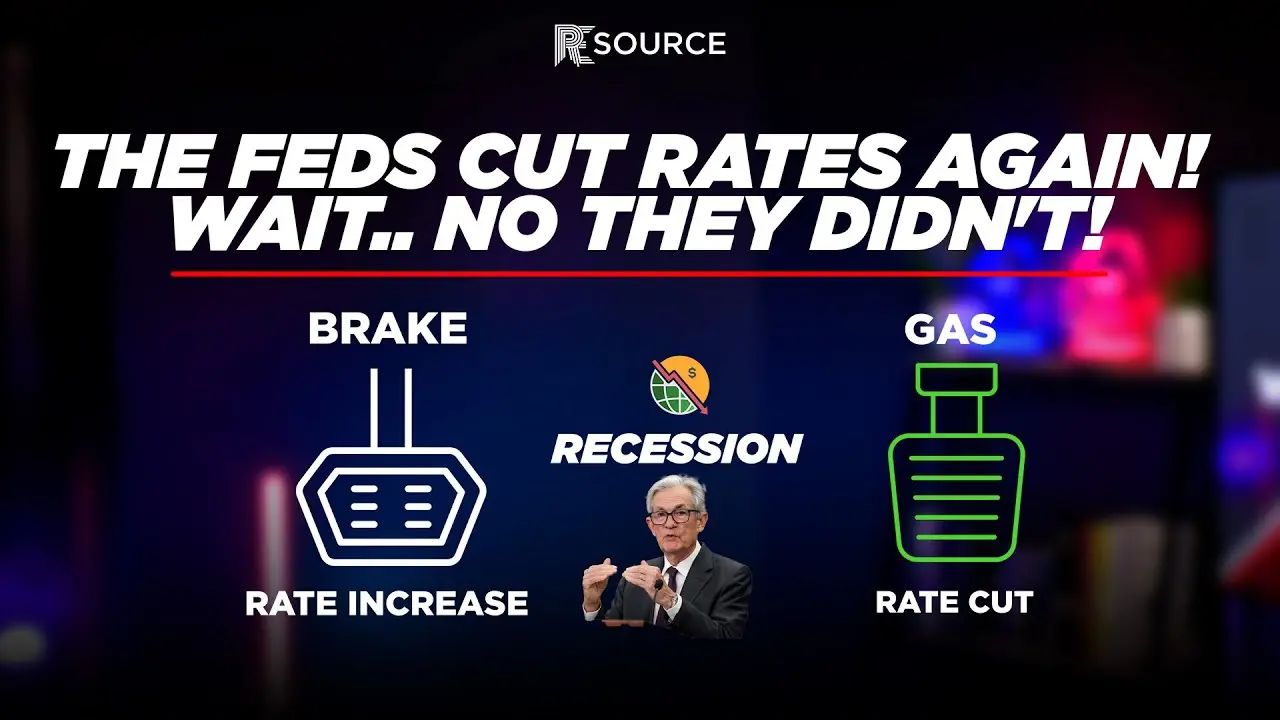
The Fed uses rate cuts and increases as tools to manage the economy. A rate cut acts as a gas pedal, intended to stimulate economic activity when the economy is sluggish. Conversely, a rate increase serves as a brake to cool down an overheating economy, often indicated by rising inflation. 

In September, the jobless claims report indicated low unemployment, suggesting a robust economy that did not require a rate cut. This single data point spooked the markets, leading to an increase in mortgage rates despite the Fed's intentions.

The October Rate Cut

Fast forward to October 29, when the Fed announced another quarter-point rate cut. Similar to September, the market had already priced in this cut, with a 98.9% certainty that it would occur. However, once again, mortgage rates rose instead of falling. 

The Influence of Jerome Powell's Statements

The key difference this time was not an economic report but rather the comments made by Fed Chair Jerome Powell during the press conference following the rate cut announcement. Powell indicated that the anticipated rate cut in December was not guaranteed, which caught the market off guard. His remarks suggested uncertainty about future monetary policy, leading to a spike in mortgage rates.

As Powell spoke, mortgage-backed securities began to decline, and mortgage rates increased by 30 basis points, contrary to the expected decrease of 25 basis points. This reaction highlights how sensitive the mortgage market is to the Fed's communications and the overall economic outlook.

Conclusion

The recent Fed rate cuts have not resulted in lower mortgage rates as many had hoped. Instead, economic indicators and the Fed Chair's statements have played significant roles in shaping market expectations and reactions. Understanding these dynamics is crucial for realtors and consumers alike.

As we continue to navigate these economic changes, it is essential to stay informed and share this knowledge with others who may benefit from it. The complexities of monetary policy and its impact on the housing market are vital for making informed decisions in these uncertain times.

July 15, 2025

Is This Summer the Season for a Kitchen Makeover?

Summer Kitchen Trends: Brighten Up Your Space


Is This Summer the Season for a Kitchen Makeover?

With warmer days beckoning, many homeowners are finally tackling that long-awaited kitchen transformation. Here’s a snapshot of what’s trending:

💼 Modern Features & Tailored Storage

  • Hidden Harmony: Built-in appliances, flush cabinetry, and appliance garages are fueling the rise of concealed kitchens. The result? A sleek, minimalist haven that flows seamlessly into open living spaces. (Martha Stewart, Decorilla)

  • Pantry Power: Big, well-organized pantry zones—think walk-in or scullery-style—are all the rage. They streamline storage and keep daily clutter hidden, giving the main kitchen a higher-end feel. (Decorilla)

🔄 Islands Evolve into Multifunctional Hubs

Kitchen islands are no longer just prep zones—they’re transforming into versatile command centers. Expect integrated sinks, cooktops, outlets, wine fridges, and seating areas perfect for family time or casual entertaining. (Decorilla)

🌞 Bring the Outdoors In

Designers are creating fluid indoor/outdoor transitions—with large windows, seamless materials, and outdoor kitchens that marry form and function. Imagine entertaining poolside with built-in grills and weather-smart finishes.

🎨 Color & Curves: Style Meets Warmth

  • Bold Hues: After years of all-white kitchens, vibrant hues are making a comeback—earthy olive greens, warm browns, rich blues, and even retro reds and yellows. (Livingetc)

  • Curvy Details: Rounded edges on islands, counters, and cabinetry soften the kitchen's look and bring in a sculptural elegance. (Jenna Sue Design)

🏛️ Vintage Accents & Natural Texture

  • Retro Revival: Expect nods to the past—checkerboard floors, tile backsplashes, and even 80s/90s cabinetry styles with a modern twist.

  • Material Magic: Large-format tiles, raw plaster range hoods, fluted panels, natural stone, and brass hardware are championing texture and sophistication.

🛠 Lasting, Functional Upgrades

  • Durable Design: With hardworking materials—stone counters flowing up walls, stainless-steel accents, and eco-tiles—these kitchens are made to last. (Architectural Digest)

  • Intelligent Layouts: Emphasis is on work triangles with hidden prep zones, cozy dining nooks, and sometimes separate "dirty kitchens" for serious cooks. (House Beautiful)


Why Summer Is the Perfect Time

  1. Natural Light Boosts Inspiration: Longer days make this season ideal for evaluating daylight impact and designing around it.

  2. Weather-Friendly Renovations: Outdoor work—like extending living space or installing new windows—is easiest without winter's moisture or chill.

  3. Vacation-Mode Patience: If you're home on summer break, managing dust and installation is less disruptive.


Inspiration Gallery

Check out some summer kitchen design ideas to jumpstart your vision!

  • Coastal outdoor cooking with hardie-plank ceilings and black countertops (Livingetc, impressiveinteriordesign.com)

  • Bright, airy indoors featuring light finishes, sculptural islands, and natural stone (Decorilla)

  • Covered outdoor pavilions with full grilling stations, stone fire features, and patios

  • A charming al fresco cooking nook nestled among greenery with dedicated prep surfaces


Your Summer Remodel Checklist

Task Tip
📐 Plan storage wisely Custom pantry & appliance garages keep counters clear.
🏝 Embrace outdoor spaces Durable outdoor touches upgrade livability.
🎨 Color thoughtfully Try paint swatches or modular panels in bold colors.
🪵 Add texture Materials like brass, fluted wood, and art tile enrich dimension.
🔀 Shape with curves Soft edges on islands and counters elevate aesthetics.
💡 Prioritize light Design around daylight, install task/ambience lighting strategically.

Final Take

Yes—summer is prime time for a kitchen upgrade. Whether you aim for concealed luxury, bold colors, or seamless outdoor transitions, the season lends itself to bright inspiration and smooth execution. With endurance, comfort, and flair at the core, you’ll create a kitchen that’s effortlessly on-trend and timelessly inviting.


RECENT KITCHEN RENOVATION NEWS!

July 10, 2025

Top 10 Questions Home Buyers Ask About Brevard County Real Estate (2025 Edition)


Top 10 Questions Home Buyers Ask About Brevard County Real Estate (2025 Edition)

If you're considering buying a home in Brevard County, Florida, you're not alone. With beautiful beaches, top-rated schools, and a growing job market, this coastal county continues to attract homebuyers from across the state and beyond. But before you make a move, you likely have questions. Below, we’ve compiled the top 10 questions buyers ask—answered by Brevard County real estate expert Karen Fleckinger.

1. Is Brevard County a good place to buy a home in 2025?

Yes, Brevard County continues to be a smart place to buy real estate. Despite a slight year-over-year decline in median home prices of 3.2%, the area remains in high demand due to its aerospace industry, growing population, and excellent coastal location. Inventory has increased by 27%, which gives buyers more choices and negotiation power.

2. What are the best cities to live in Brevard County?

It depends on your lifestyle:

  • Melbourne – Great for families and young professionals.
  • Viera – Master-planned, safe, and ideal for retirees or executives.
  • Cocoa Beach – Beachfront living and vacation vibes.
  • Palm Bay – Affordable with plenty of new construction.
  • Rockledge – Suburban feel with excellent schools.

3. What’s the average home price in Brevard County?

As of July 2025, the median home price is approximately $360,000. New construction homes typically start in the $300K–$500K range, while beachside properties can exceed $700K+.

4. Is it better to buy Brevard New Construction or Resale?

New Construction Pros:

  • Lower interest rate incentives
  • Up to $20,000 in builder-paid closing costs
  • No repairs or unknowns

Resale Pros:

  • Established neighborhoods
  • Potentially larger lots
  • Immediate availability

If you're interested in a list of new homes with incentives, click here.

5. What are the best school zones in Brevard County?

Top-rated schools include:

  • Quest Elementary (Viera)
  • West Shore Jr/Sr High (Melbourne)
  • Edgewood Jr/Sr High (Merritt Island)

Brevard’s public school system is highly ranked in Florida, making it attractive to families.

6. How close is Brevard County to major cities and airports?

  • 45–60 mins to Orlando International Airport
  • 30–45 mins to Disney/Orlando attractions
  • 2–3 hours to Miami or Jacksonville

Many buyers love the mix of quiet coastal living with easy access to bigger metros.

7. What should I know about flood zones and insurance?

Some beachside and riverfront areas fall into flood zones, which can increase insurance premiums. Always get a flood zone report before closing. We help our clients navigate this and connect with trusted insurance providers.

8. Are there good retirement communities in Brevard?

Yes. Popular 55+ communities include:

  • Bridgewater at Viera
  • Heritage Isle
  • Lakes of Melbourne
  • Forest Lakes of Cocoa (manufactured homes)
  • Lost Lakes  (manufactured homes)

These offer amenities like pools, clubhouses, and gated security—perfect for active adults.

9. What are property taxes like in Brevard County?

The average effective rate is around 0.83%, lower than many other parts of Florida. Homestead exemptions and portability can further reduce your tax burden.

10. How do I get started buying a home in Brevard County?

The first step is a local expert consultation. Whether you're just browsing or ready to tour homes, I’m here to guide you with neighborhood knowledge, financing options, and insider listings. Or visit our Brevard Home Finder Quiz Page and let us help you find your perfect home!

Looking to buy in Brevard County?

📞 Call Karen Fleckinger at 321-693-4322

📧 Email: karen@housemaxpro.com

🌐 www.brevardhomesearch.com

March 3, 2025

Is Now a Good Time To Buy A Home?

Did you know that 80% of Americans think it's a bad time to buy a house right now! This is absolutely true!

So now let's take a minute to look at the chart below and see if you see the same trend I see...

This is a chart documented by FRED (Federal Reserve Economic Data) starting in 1963 through 2024.  As you can see home values have ALWAYS been increasing with a few minor ups and downs during that time. 

The chart of home values dates back to the first quarter of 1963 the average home value then was $17,800 the graph ends at the fourth quarter of 2024 and the value then was $419,200 over that 62 plus year span we have seen no discernable downturn in home values at all in that period.

We have seen the70s oil embargo, the Great Recession and the COVID Pandemic which was a second large recession in this time and none of them, zero, had any lasing Impression whatsoever on real estate values. So, if you hold real estate it will always go up in value which makes it the best investment you can ever make right now. Also, real estate is the only investment that you get to live in, sleep in,  throw beer pong parties in, raise your kids in and share dinner with friends and create memories in and get to know the community in....

So is it a bad time to buy a home tomorrow...NO! It's going to be more expensive and you will loose out on everything I spoke about above. (If you are renting right now rental prices go up exponentially with home prices!)

Now is the perfect time to reach out to us and let us help you fine the Perfect home with our Perfect Home Finder program.  So just reach out to us via phone or email and let us help you find your next home.

Karen Fleckinger 321-693-4322 karen@housemaxpro.com

P.S.  
If you have a home to sell,  CLICK HERE to get not one, but 4 instant valuations of your home from different resources, as well as Instant Cash Offers.  No Obligation!


Feb. 6, 2025

Where is the cheapest place to live in Brevard County, Florida?

In Brevard County, Florida, several areas are recognized for their affordability based on factors such as median home prices and cost of living. Notable communities include:

  • Port St. John: With a median home price of approximately $199,786 and a median rent of $1,420, Port St. John is considered one of the most affordable areas in the county.


  • Mims: Identified as a community with a lower cost of living, Mims offers affordable housing options.


  • Cocoa: This city is also noted for its affordability within Brevard County.


These areas provide more budget-friendly living options compared to other parts of the county. However, it's essential to consider factors such as employment opportunities, amenities, and lifestyle preferences when choosing a place to live.

What is your Brevard County Home Worth

Find Unlisted Brevard County Homes For Sale

Feb. 6, 2025

Are home prices dropping in Brevard County, Florida?

As of early 2025, the housing market in Brevard County, Florida, exhibits mixed trends regarding home prices. According to Rocket Homes, the median home sold price in January 2025 was $360,408, reflecting a 3% increase from the previous year. Similarly, Redfin reports a 1.9% year-over-year increase in the median sale price, reaching $357,000 in December 2024.


Conversely, Zillow indicates a 2% decrease in the average home value over the past year, bringing it to $344,700 as of December 31, 2024.


These varying reports suggest that while some data sources show a modest appreciation in home prices, others indicate a slight decline. Overall, the market appears relatively stable, with no significant downward trend in home prices.

To learn what your home is worth visit BrevardHouseValues.com

April 21, 2023

What is the difference between a pre-approval and a pre-qualification in the mortgage process?

When you are in the process of buying a home, a pre-qualification and pre-approval are two important terms that refer to different stages in the mortgage process. Here's what you need to know about the differences between pre-qualification and pre-approval:

Pre-Qualification:

Pre-qualification is an informal process where a lender will look at some basic financial information provided by the borrower, such as their income, debt, and assets, and give an estimate of how much money they might be able to borrow. It is typically a quick process that can be done online or over the phone.

Pre-qualification does not involve a credit check or a thorough examination of your financial documents, so it's important to keep in mind that it is only an estimate of what you might be able to afford. It does not guarantee that you will be approved for a loan, and it does not commit the lender to give you a loan.


Pre-Approval:

Pre-approval is a more formal process that involves a thorough examination of your financial documents and credit history. During pre-approval, the lender will typically ask for documentation of your income, assets, and debts, as well as perform a credit check.

Based on this information, the lender will determine how much money they are willing to lend you and give you a pre-approval letter that you can use to show sellers that you are a serious buyer. Pre-approval is more valuable than pre-qualification because it shows that the lender has already reviewed your financial information and is willing to give you a loan.


In summary, pre-qualification is a quick estimate of what you might be able to afford, while pre-approval is a more formal process that involves a thorough examination of your financial documents and credit history. Pre-approval is more valuable than pre-qualification because it shows that the lender has already reviewed your financial information and is willing to give you a loan.


Jan. 18, 2023

Have Home Values Hit Bottom?

Have Home Values Hit Bottom?

Have Home Values Hit Bottom? | MyKCM

Whether you’re already a homeowner or you’re looking to become one, the recent headlines about home prices may leave you with more questions than answers. News stories are talking about home prices falling, and that’s raising concerns about a repeat of what happened to prices in the crash in 2008.

One of the questions that’s on many minds, based on those headlines, is: how much will home prices decline? But what you may not realize is expert forecasters aren’t calling for a free fall in prices. In fact, if you look at the latest data, there’s a case to be made that the biggest portion of month-over-month price depreciation nationally may already behind us – and even those numbers weren’t significant declines on the national level. Instead of how far will they drop, the question becomes: have home values hit bottom?

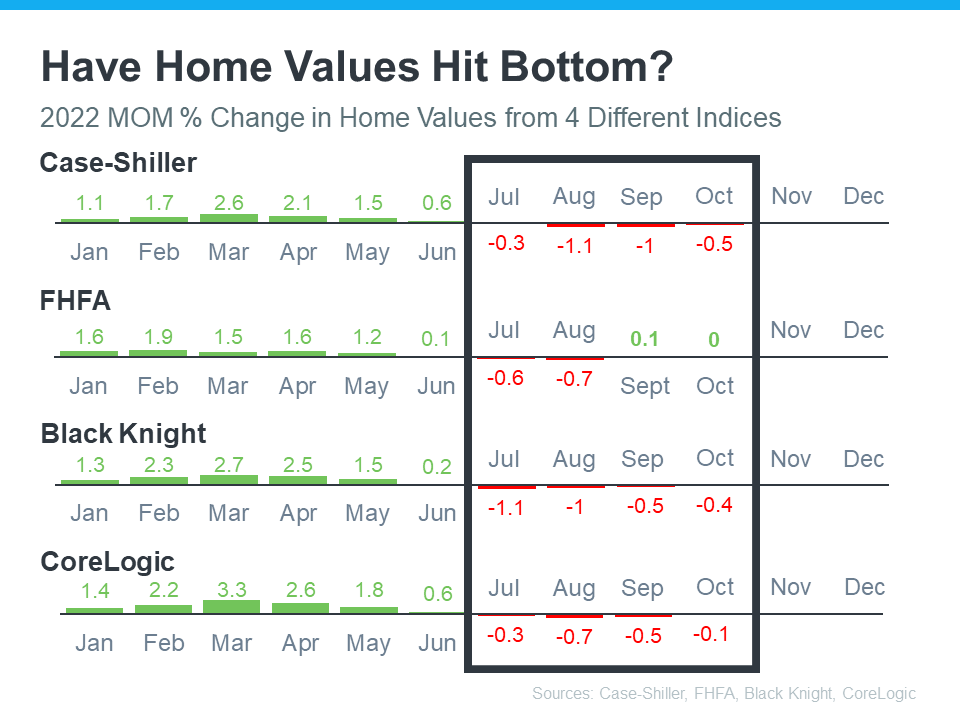
Let’s take a look at the latest data from several reputable industry sources (see chart below):

Have Home Values Hit Bottom? | MyKCM

The chart above provides a look at the most recent reports from Case-Shiller, the Federal Housing Finance Agency (FHFA), Black Knight, and CoreLogic. It shows how, on a national scale, home values have changed month-over-month since January 2022. November and December numbers have yet to come out.

Let’s focus in on what the red numbers tell us. The red numbers are the change in home values over the last four months that have been published. And if we isolate the last four months, what the data shows is, in each case, home price depreciation peaked in August.

While that doesn’t guarantee home price depreciation has hit bottom, it confirms prices aren’t in a free fall, and it may be an early signal that the worst is already behind us. As the numbers for November and December are released, data will be able to further validate this national trend.

Bottom Line

Home prices month-over-month have depreciated for the past four months on record, but there’s a strong case to be made that the worst may be behind us. If you have questions about what’s happening with home prices in our local market, let’s connect.

Jan. 14, 2023

The Truth About Negative Home Equity Headlines

The Truth About Negative Home Equity Headlines

The Truth About Negative Home Equity Headlines | MyKCM

Home equity has been a hot topic in real estate news lately. And if you’ve been following along, you may have heard there’s a growing number of homeowners with negative equityBut don’t let those headlines scare you.

In truth, the headlines don’t give you all the information you really need to understand what’s happening and at what scale. Let’s break down one of the big equity stories you may be seeing in the news, and what’s actually taking place. That way, you’ll have the context you need to understand the big picture.

Headlines Focus on Short-Term Equity Numbers and Fail To Convey the Long-Term View

One piece of news circulating focuses on the percentage of homes purchased in 2022 that are currently underwater. The term underwater refers to a scenario where the homeowner owes more on the loan than the house is worth. This was a huge issue when the housing market crashed in 2008, but it's much less significant today.

Media coverage right now is based loosely on a report from Black Knight, Inc. The actual report from that source says this:

Of all homes purchased with a mortgage in 2022, 8% are now at least marginally underwater and nearly 40% have less than 10% equity stakes in their home, . . .”

Let’s unpack that for a moment and provide the bigger picture. The data-bound report from Black Knight is talking specifically about homes purchased in 2022, but media headlines don’t always mention that timeframe or provide the surrounding context about how unusual of a year 2022 was for the housing market. In 2022, home price appreciation soared, and it reached its max around March-April. Since then, the rate of appreciation has been slowing down.

Homeowners who bought their house last year right at the peak or those who paid more than market value in the months that followed are more likely to fall into the category of being marginally underwater. The qualifier marginally is another key piece of the puzzle the media isn’t necessarily including in their coverage.

So, what does that mean for those who purchased a home in 2022? It’s important to remember, owning a home is a long-term investment, not a short-term play. When headlines focus on the short-term view, they’re not necessarily providing the full context.

Typically speaking, the longer you stay in your home, the more equity you gain as you pay down your loan and as home prices appreciate. With recent market conditions, you may not have gained significant equity right away if you owned the home for just a few months. But it’s also true that many homeowners who recently bought their house are unlikely to be looking to sell quite yet.

Bottom Line

As with everything, knowing the context is important. If you have questions about real estate headlines or about how much equity you have in your home, let’s connect.